

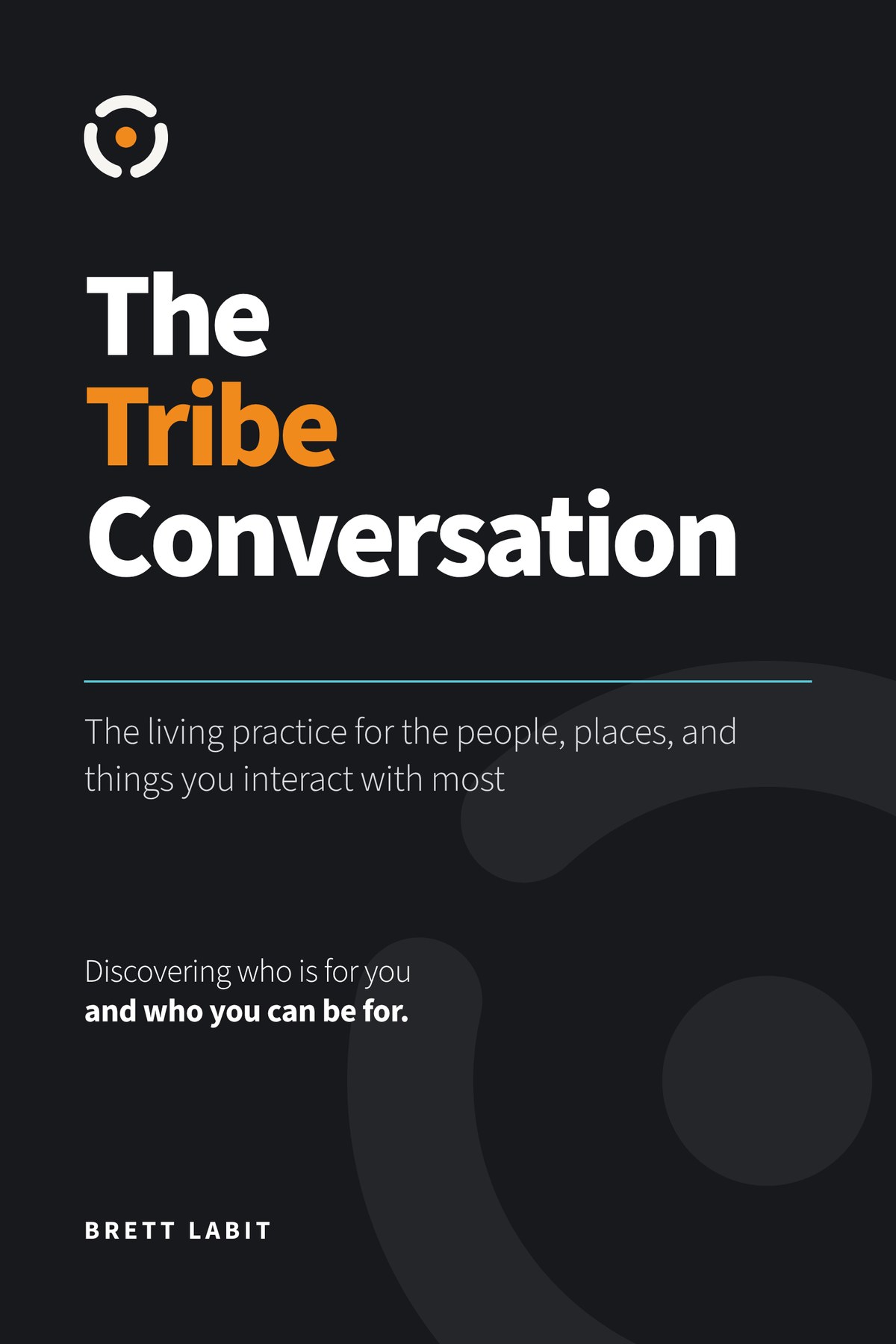
Who is for you, and who you are for.
Whether or not you realize it, you already keep a ledger of who is for you and who you are for: in a room, in the text that didn't come, in the friend who shows up and the one who only calls when they need something. Knowing the ledger is one thing. Having the courage to change it is another. To consciously choose and accept the right people into your tribe, and to no longer allow and tolerate the wrong ones. "There is no amount you can invest in the wrong person to convert them into the right one for you."
Thriving with your tribe takes a high degree of self-honesty, self-honor, and the honoring of others. You only have so much time, money, and energy to allocate to the right people, places, and things, and your best life is built from where you put them. Do this consciously and you start living it now, not later. Unconsciously, you settle for less than your highest and best.
This book gives you immediate tools of language and distinctions to build the confidence and courage to choose who to live your best life with. See who is where and what to you in your tribe, and who you are to them. You don't find your tribe. You consciously curate it, one choice at a time.
The first pages.
Chapter One, The Paradigm We Were Handed
Over a decade ago, I began diligently asking: What is success, and how do we sustain it? To make a long story short, I found the question itself to be a trap. In time, my mentor John King helped me out of the trap and onto a more productive path. He helped me convert the question into an inquiry, and now, fourteen years later, I am still happily inside that inquiry. It has never closed. I have simply stopped needing it to.
Here is the trap: success has been used, almost universally, in category error. For most of us, it has been superimposed onto our identity, or onto how we place identity on others. He is successful. She is a failure. But this is not possible, in either direction. No one’s whole identity is ever fully one or the other; that was never the nature of success to begin with. You already know this. You have said it yourself, probably without noticing the weight of it: you win some, and you lose some.
We are not always succeeding, and we are not always failing, so our identity cannot be either one. We succeed at some things, sometimes, and we fail at others, at other times; often in the very same week, sometimes in the very same hour. Both are happening simultaneously, all the time. This is simply living, and what we do while we’re alive.
A rockstar can be succeeding at fame and failing in her personal life. A mother can be succeeding at raising her children while quietly failing to maintain her own identity, sacrificing her passions without telling anyone, including herself. A CEO can be succeeding at generating net worth while quietly failing the person he shares his life with. A freelancer can be succeeding at winning clients, failing at managing money, succeeding at the work itself, and failing to protect their own health, all in the same season. This is what life actually looks like. Neither success nor failure was ever going to be an accurate description of the whole person.
Why this matters
After years spent trying to understand success, and consequently failure, and the toll our comparisons take on us, I found a healthier and more accurate way of being. It took me forty-two years, and four more spent in the wreckage, to begin. I want to tell that part once, properly, because the way I usually tell it is a lie of compression.
The face I see first is not from 2008. It is from 2006, in the office of my friend Joe, whose real estate brokerage I was working in at the time. We were close, and he pulled me in for a chat and said, "You know what your problem is? You have incredible talent." He went on to explain that my talent was hurting me, and he was right. I had leaned on it since I was a teenager, since the family friend in the back seat of my parents' car on the way to McCall, Idaho, told me I could run a corporation better than most CEOs. People said things like that to me often enough that I believed my press clippings. Talent let me do better than most with less effort, and it kept me from ever developing the ways of being that would have taken me the rest of the way. I had enough achievement that life was good, and I held onto it, for a while, and I could never put a finger on why the great life I imagined stayed just out of reach. Joe's assessment was more accurate than even he knew, and it haunted me.
Then 2008 came. I was a real estate agent and a real estate investor, and my wife at the time was in real estate too, and you know how that story goes. The crisis took the career, or at least any desire to go on with it. It took the investment properties. It took the six-thousand-square-foot home I was remodeling with cash. Money comes and goes, and I had lost it before and knew you could get it back. What I lost this time was worse: my confidence, my sense of direction, and my belief that I understood how life worked. And it was not only 2008. The crash was a tipping point stacked on earlier failures, in business, in marriage, in parenting, and what had been seasons of being paid and celebrated had also been seasons of crashing marvelously, more than once. That is called learning. I did not know it yet.
So I lingered, for four years. Grief, then blame, then cynicism, then stretches I would now call depression. In the beginning I was bitter and victimized, pointing at what had happened to me as if it had not happened to anyone else, and that phrase is the tell, because victimhood always requires believing your suffering is exceptional, and mine was not; it happened to millions. But a paradigm in collapse does not produce perspective. It produces a story, and I lived inside mine. By 2012 I was forty-two, and my younger sister had to take me to the grocery store, and we sat in the aisle arguing and crying while she kept putting things in the cart and I kept insisting I only needed peanut butter, bread, and milk. The talented Brett Labit of the stories I had believed had not just lost everything. He was lost.
The chapter goes on from here.
Tell me when it's outThree doors, one book.
The Person
Your life, your people, and how you show up for them.
Read The Person →The Professional
Building a business and stuck, because you can't get to it all and can't hire your way out of it?
Read The Professional →The Organization
Teams, boards, and communities: how a group of people becomes a tribe that leads itself.
Read The Organization →
Brett Labit
Brett Labit is a Life Leadership Coach and the founder of TribeUp. He has spent fourteen years inside one inquiry, how people interact, relate, and lead, and he leads The Tribe Conversation from Sedona, Arizona, where he also leads three art galleries and serves his city. This is his first book in the series.
Hear first.
Two fields. The day the book is out, you'll hear from me before anyone else does.
Preview link: this is what a person sees. Nothing was sent.
You'll hear first.
A note from me is on its way to your inbox now. The day the book is out, you'll be the first to know.
If it doesn't arrive in a few minutes, check your spam folder, then write me at brett@brettlabit.com.